New Construction ★ Fort Sill Area
Closing Costs on New Construction in Oklahoma: What You'll Actually Pay
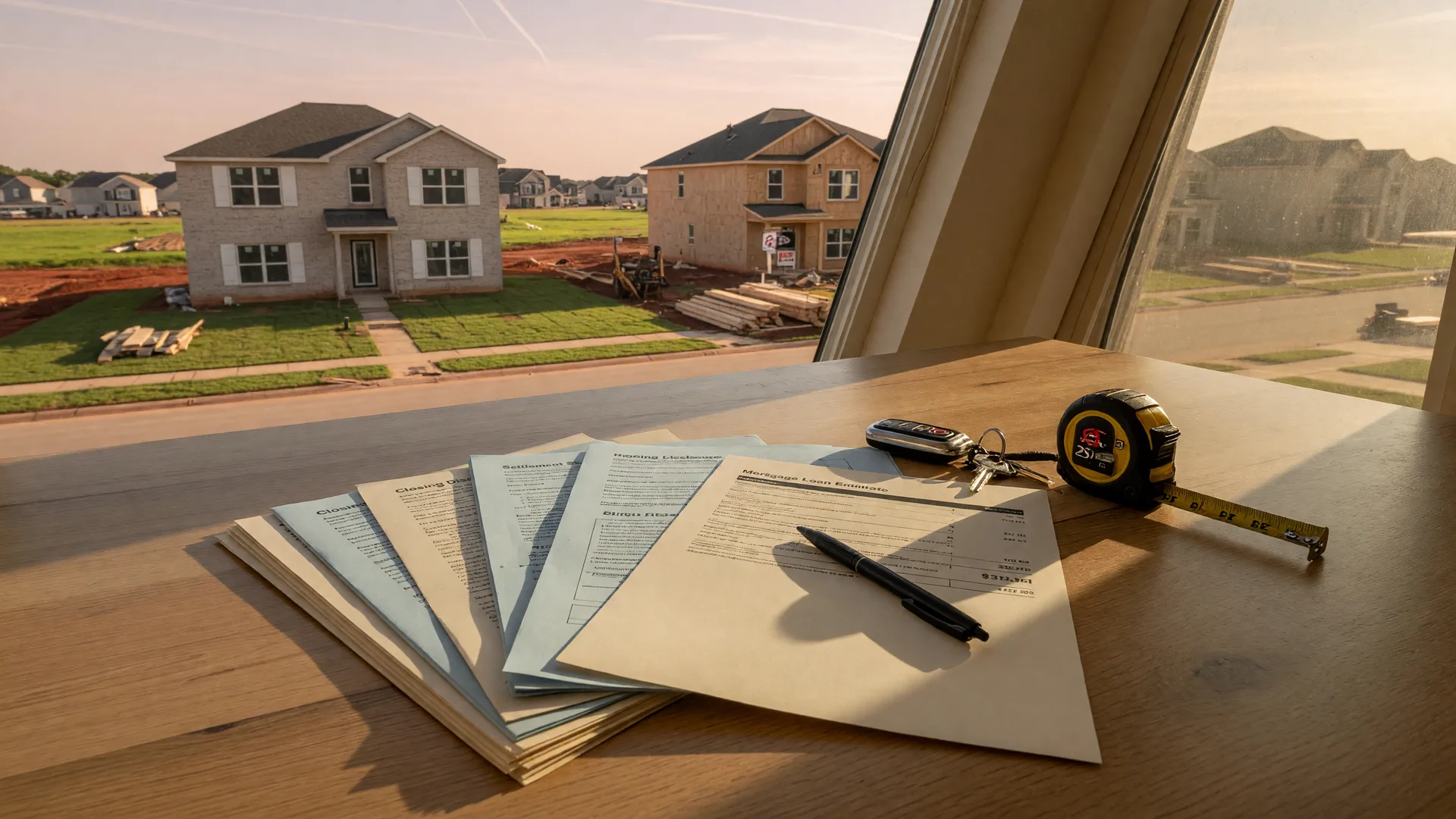
How much are closing costs on new construction in Oklahoma? For an Elgin new build in the common $375,000 to $435,000 range, budget roughly 2 to 4 percent of the purchase price before any builder credit, which lands most buyers at about $7,500 to $17,000, plus the VA funding fee when it applies. Oklahoma keeps two of the biggest lines affordable: there is no state transfer tax on the buyer side, and title insurance rates are state-regulated, so the surprise is usually not the title work. It is the escrow prepaids and the funding fee. Here is the breakdown I walk every new-construction buyer through at the contract stage.
★ The short answer: budget 2 to 4 percent of the price
On a typical Elgin new build, plan on closing costs of roughly 2 to 4 percent of the purchase price before any builder contribution. On a $380,000 home, that is about $7,600 to $15,200. If you are using a VA loan and you pay the funding fee out of pocket, add the fee on top. If you finance it, add the payment to your monthly number instead.
National analyses have put typical buyer-paid closing costs around 2 to 5 percent of the purchase price, and data specific to Oklahoma has historically run on the lower end of that band, around 1.5 to 2 percent on average. New construction tends to sit at the higher end of the Oklahoma range because the buyer pays the lender, title, and escrow lines directly, with no existing seller in the transaction to share them. The exact number always comes from your lender's Loan Estimate, not from a rule of thumb.
The article on new construction costs in Elgin puts current price ranges on today's builds, so you can apply the percentage to a number that fits your budget.
★ Why new construction closing costs differ from resale
On a resale, buyer and seller split the closing pie through the contract: who pays the title policy, the tax stamps, the repairs. On new construction, the builder is the seller, and builders price homes expecting to carry certain costs themselves and pass the rest to you. The trade-off usually shows up as a credit line on the closing statement, a builder contribution toward your lender fees or title work, so the quoted price and the cash you bring to closing are two different numbers.
There are also two lines that are unique to new builds. You may reimburse the builder for property taxes they paid while your home was under construction, prorated to your closing date. And if the community carries assessments or a homeowners association, you may prepay dues the builder advanced during the build. Neither is large on its own, but both appear on the statement, so ask your agent or closing attorney to flag them before closing day.
The Buying Process and New Construction Explained guide covers the contract side of new builds, and the New Construction Communities page lists Elgin's active builders so you can compare their standard inclusions before you ever sign.
★ The line-by-line breakdown: what you actually pay for
Here is the one-page list I keep for every new-construction client. Lender-dependent lines are marked as estimates, and nothing is final until the Loan Estimate arrives.
- Loan origination and underwriting fees, which vary by lender and are always negotiable.
- Appraisal: usually $500 to $900, and on a VA new build the appraisal runs through the VA process with its own timeline and an as-completed format.
- Credit report and lender's title work: small but ever-present lines.
- Title insurance: a lender's policy, plus an owner's policy if you take one. Oklahoma rates are state-regulated, so the quote is similar across title companies; an owner's policy on a $380,000 home runs roughly $1,200.
- Recording fees for the deed and the mortgage, set by the county, typically a few hundred dollars.
- Escrow prepaids: property taxes and homeowners insurance, funded at closing and held by your servicer. This is often the largest non-lender line on the statement.
- A survey, when your contract or lender requires one. On most new builds the builder's plat covers the lot, so confirm whether your lender will accept it.
- The VA funding fee, if you use a VA loan and are not exempt: 2.15 percent of the loan amount for a first-time buyer with less than 5 percent down at 2026 rates, and it can be financed into the loan.
★ Two Oklahoma rules that keep costs predictable
First, there is no state real estate transfer tax that Oklahoma buyers pay. The state instead charges a documentary stamp tax on the deed, $0.75 per $500 of the consideration, and who pays it is written into the contract; customarily the seller, which on new construction means the builder, pays. On a $380,000 home the stamps come to $570. Customs are not law, so read the contract line before signing.
Second, Oklahoma title insurance premiums are set through approved rate filings, so the quote barely moves between companies. That removes one of the most annoying shopping exercises in real estate: the price is the price, and the difference between title companies is service, not cost.
The documentary stamp tax is set out in Oklahoma Statutes Title 68, Section 3201.
★ What the VA funding fee means for your closing costs
For VA buyers, the funding fee is the line that changes everything. At the rates in effect for 2026: first use with less than 5 percent down is 2.15 percent of the loan amount, 5 to 9.99 percent down is 1.50 percent, 10 percent or more down is 1.25 percent, and a subsequent use with less than 5 percent down is 3.30 percent. On a $380,000 loan at the 2.15 percent tier, that is about $8,170.
The fee is either paid at closing or financed into the loan, and it is waived for veterans receiving VA disability compensation, with the exemption also covering eligible surviving spouses. If you have a service-connected rating, say so early. The exemption affects your loan math, not just a line at closing.
The current fee schedule and exemption rules are published on VA.gov's funding fee and closing costs page, and the VA Loan and BAH on New Construction guide applies the numbers to the Fort Sill and Elgin context.
★ With a VA loan, what can a builder pay for you?
The VA does not cap a seller or builder paying your actual closing costs. Title, appraisal, recording, lender origination, and permissible points can all be paid by the seller. What the VA does cap is seller concessions, defined as things of value beyond closing costs: the funding fee, prepaid taxes and insurance, interest rate buydowns, or free upgrades. Those are limited to 4 percent of the home's reasonable value, and on a new build the incentive has to be written into the sales contract to count.
The practical version: a builder credit aimed squarely at closing costs is generally fine under VA rules, while a package of free upgrades or a large rate buydown eats into the 4 percent concession headroom. Your lender runs that math. Your job is to ask, up front, how a builder incentive will be classified on a VA loan before you fall in love with it.
The official program rules are on VA.gov, and the article on VA loans for Elgin new builds covers the builder and appraisal side of the process.
★ Builder incentives and lender credits: how to read the offer
Elgin-area builders run incentive programs that rotate by season, phase, and the lots left in a release: contributions toward closing costs, prepaid items, rate buydowns, or upgrades. None of it is permanent, and none of it is free money, so get the current program in writing and compare it honestly against the cash you would actually receive.
The most common structure pairs a credit with the builder's preferred lender. Compare the two side by side: the rate and fees from your own lender versus the builder lender's rate and fees minus the credit. A credit is only worth its face value if the paired rate and costs are competitive. Ask both lenders for a Loan Estimate if you qualify for one, then read the two columns before choosing.
The article on buyer representation with builders explains why your agent, not the builder's sales office, is the one who should help you run this comparison.
★ How to get your real number before you pick a house
Three documents give you the real number, in order. Within three business days of your loan application, the lender must send a Loan Estimate itemizing your costs. Before closing, you receive a Closing Disclosure with the final numbers, and by law you have three business days to review it before signing. On new construction, add the builder's closing statement, which shows the credit and any construction-period reimbursements, so the builder's sheet and the lender's sheet have to be read together.
Ask for the numbers at the contract stage, not after you sign. In the Elgin market, the difference between $6,000 and $13,000 in cash to close changes which build you can afford. Nothing below is a quote, and no one's quote is yours until your lender puts it on paper.
★ Is Elgin different from the rest of Oklahoma on closing costs?
Not structurally. The same state rules apply across Oklahoma, and Elgin's tax district and Comanche County fees follow the same pattern as the rest of the area; your closing attorney or title company will give the town-specific lines. What differs in Elgin is the purchase price, the half-acre to one-acre homesites, and the new-build share of the market, and all three simply scale the percentage.
One Elgin-specific note: a brand-new home goes on the tax rolls at its full fair cash value, and Oklahoma's 3 percent annual assessment cap does not apply in the first year, so the property tax line on a new build's escrow is often higher than on a similarly priced resale. Budget for it, and ask for the expected number before you commit.
The new construction vs resale comparison explains the property tax mechanic in detail, and the VA Loan and BAH guide shows how the whole monthly math works on an Elgin build.
★ Can a builder pay my closing costs on a VA loan?
Yes, generally. The VA allows the seller or builder to pay your allowable closing costs, and those payments are not counted against the 4 percent seller concession limit. The concession cap applies to other value: the funding fee, prepaid taxes and insurance, buydowns, and upgrades. Ask your lender to classify any builder incentive on paper before you sign, and confirm how it is documented in the sales contract.
★ How much are closing costs on a $380,000 new construction home in Oklahoma?
At 2 to 4 percent of the price, roughly $7,600 to $15,200, with the exact amount driven by lender fees, escrow prepaids, and whether the VA funding fee applies. Oklahoma's lower-than-average title and tax lines usually keep buyers toward the middle of that band when no funding fee is in play, and a builder credit or incentive can lower it further.
★ Is the VA funding fee waived for disabled veterans?
Yes. Veterans receiving VA disability compensation are exempt from the VA funding fee, and the exemption also covers eligible surviving spouses. If you qualify, tell your lender early so the math on your loan is right from the start, and keep your eligibility documentation ready for the loan file.
The exemption is explained on VA.gov's funding fee page.
★ Who pays the documentary stamp tax on a new build in Oklahoma?
Customarily the seller, which on new construction means the builder, but who pays is negotiated and written into the contract. The tax is $0.75 per $500 of the consideration, so on a $380,000 home it is about $570. Look for the line in the contract and make sure you know which side of the deal it lands on before you sign.
★ Do I pay closing costs at contract signing or at closing?
Both, in a way. At contract you put down earnest money, and you pay for options and upgrades as you select them during the build; those sit outside closing costs. The closing costs themselves, the lender, title, escrow, and funding fee lines, are settled on the day you close. The builder's schedule for collecting upgrade payments varies, so ask for the payment timeline in writing early.
★ Can I roll closing costs into my VA loan?
The VA funding fee can be financed into the loan, and some closing costs can be added when the home's appraised value supports it, a structure your lender can explain for your specific file. For most VA buyers the clean path is: seller-paid allowable closing costs, the funding fee financed or waived, and the rest paid at closing.
★ A note on numbers and sources
The percentages, fee rates, and tax figures in this article reflect published rules and market data as of October 2026: the VA funding fee schedule on VA.gov, Oklahoma's documentary stamp tax under Title 68, and market-tracker data on typical closing costs. Incentives, lender fees, and promotional programs change constantly, so the number that matters is the one your lender prints on a Loan Estimate for your specific contract, price, and loan type.
If you want to see the real estimate for a specific Elgin build before you commit, book a free 30-minute consultation with Travis or call (580) 647-0915. Bring the builder's contract and the lot number; you will leave with a cash-to-close ballpark you can actually plan around.
Questions about this topic?
Talk it through with a local REALTOR®.
Travis Wright is a Southwest Oklahoma native, a Fort Sill relocation specialist, and a new-construction agent with eXp Realty. A 30-minute consultation is free, and there is no pressure to decide anything on the call.